Skip to content
Review Request Email Templates

Review request email templates that actually get replies

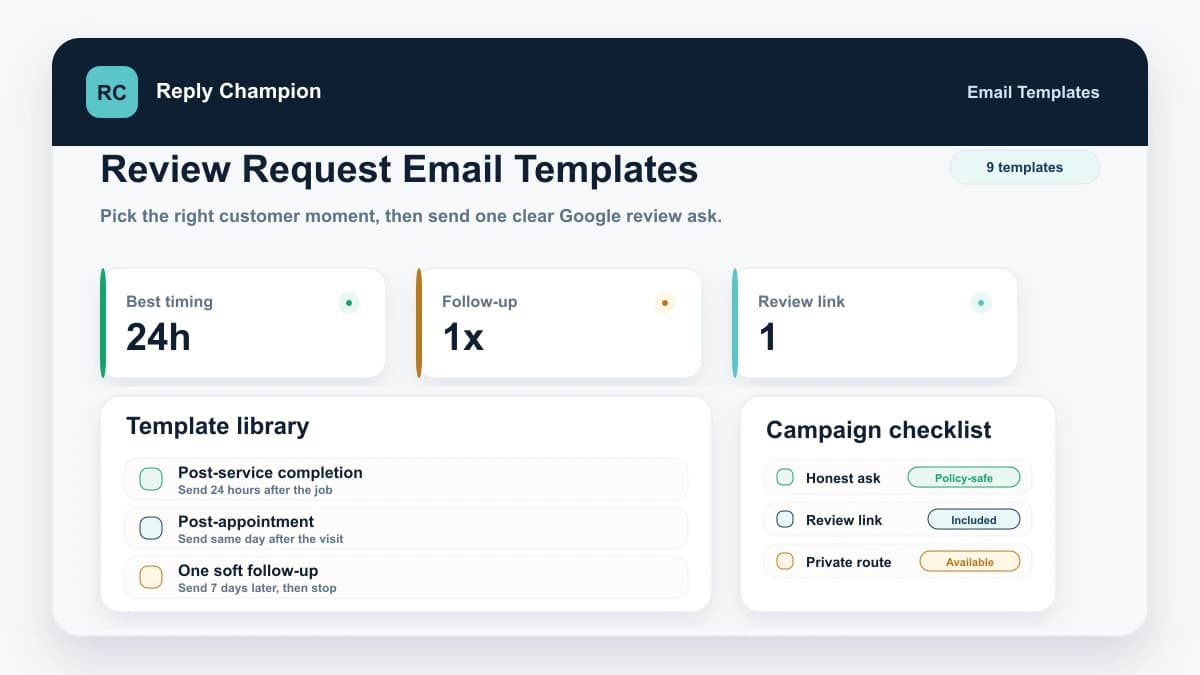
9 templates organized by when to send them, with the reasoning behind every line. Copy what fits your business, then read the part that matters more than the wording: timing.

The insight most template pages skip

Timing beats wording. Every time.

Most review request emails fail for one reason: they show up at the wrong moment. A template sent two weeks late to a customer who’s already forgotten you is dead on arrival, no matter how well it’s written. A one-sentence ask sent at the peak of the customer’s gratitude converts.

Here’s the business case for getting the timing right. A peer-reviewed study from Harvard Business School’s Michael Luca found that a one-star increase in Yelp rating correlates with a 5-9% increase in revenue for independent restaurants.1 Google reviews drive the same lift in local search visibility and click-through. You can’t get that lift without asking, and you can’t ask well without understanding when.

Every template below is organized around a specific customer moment. Match the moment, use the template as a starting point, personalize the first line, and you’ll get more reviews than 90% of your competitors.

9 Templates

The templates, organized by customer moment

Each template includes subject line variants, the body copy, the exact timing window, and an honest explanation of why it works.

1

Post-purchase (product or ecommerce)

When to send: 10-14 days after delivery is confirmed

Subject line variants

Click any line to copy

Email body

Hi [Name],

It’s been a couple weeks since your [product] arrived. I hope you’re loving it.

If you have 30 seconds, would you leave a Google review? Your honest take helps us get better and helps other shoppers know what to expect.

[Leave a review →]

Thanks,
[Your name]

Why it works

The 10-14 day window is the sweet spot for physical products. Too early and they haven’t formed an opinion. Too late and the purchase feeling is gone. The "30 seconds" framing sets a tiny commitment, and "helps other shoppers" taps pro-social motivation, which consistently outperforms pure self-interest like "help us."

2

Post-service completion (trades & home services)

When to send: 24 hours after the job is finished

Subject line variants

Click any line to copy

Email body

Hi [Name],

I hope everything’s still working great at [address] after our visit yesterday.

If you have a minute, would you share your experience on Google? It really helps other folks in [city] find honest [trade] work.

[Share on Google →]

Thanks for trusting us,
[Your name]

Why it works

Twenty-four hours is the peak gratitude window for service businesses. The problem is fresh, the relief is real, and the customer hasn’t yet noticed anything minor. Mentioning the specific address and trade makes the email feel personally sent, not blast-automated. "Helps other folks in [city]" taps local identity, which outperforms generic "help us" framing.

3

Post-appointment (healthcare, beauty, professional)

When to send: Same day, 2-4 hours after the appointment

Subject line variants

Click any line to copy

Email body

Hi [Name],

Thanks for coming in today. I hope you’re feeling great.

If you have 30 seconds, would you share how it went on Google? Your review helps other [patients / clients] find us.

[Share your experience →]

See you next time,
[Practice name]

Why it works

Healthcare and beauty appointments are high-emotion, high-memory events. Waiting a day dilutes the feeling. Same-day is the window where the experience is still vivid. "See you next time" is a subtle relationship cue that separates this from a cold ask, signaling you expect to see them again.

HIPAA note: For healthcare, don’t reference specific treatments, diagnoses, or services in the email body. Keep it generic. Reply Champion’s HIPAA-safe templates are pre-screened for these issues.

4

Post-stay (hotels, B&Bs, vacation rentals)

When to send: Morning after checkout

Subject line variants

Click any line to copy

Email body

Hi [Name],

Thanks for choosing [Hotel] for your trip. I hope you got some rest and had a great time in [city].

If you’re willing, we’d love a Google review. It’s how most new guests find us, and every review makes a real difference.

[Write a review →]

Safe travels,
[Name / Hotel]

Why it works

Morning-after is the timing sweet spot for hospitality. Guests are usually still in travel mode, the memory is fresh, and they haven’t yet fallen back into post-trip inbox overwhelm. "Got some rest" is a warm human touch. Being honest about "how most new guests find us" is the counterintuitive move that builds trust: transparency about the business case lands better than pretending the review is just for you.

5

Post-meal (restaurants & dining)

When to send: 2-3 hours after the meal, not the next day

Subject line variants

Click any line to copy

Email body

Hey [Name],

Thanks for dining with us tonight. Hope the meal hit the spot.

If you have a sec, would you leave us a Google review? It genuinely helps, and we read every one.

[Leave a review →]

See you next time,
[Restaurant]

Why it works

Same-day is critical for restaurants because food memory fades fast. A great meal becomes "a good meal" within 24 hours. "Hit the spot" is a conversational touch that reads like a real waiter wrote it. "We read every one" is a commitment that reframes the review as a conversation, not a rating, and dramatically changes reply psychology.

6

Long-relationship client (professional services)

When to send: After a clear milestone: return filed, case closed, deal closed, project delivered

Subject line variants

Click any line to copy

Email body

Hi [Name],

Just a quick note to say thank you for trusting me with [this year’s taxes / your case / this project]. I know how much it meant to you and I’m really glad we got to a good outcome.

If you have a few minutes, a Google review would mean a lot. Word of mouth is how clients find me, and your take would help the next person in your shoes.

[Write a review →]

Really appreciate you,
[Your name]

Why it works

Professional services run on referrals, so the ask has to feel personal. Mentioning the specific milestone signals you remember them as a person, not a case number. "The next person in your shoes" frames the review as paying it forward, which is a much stronger pro-social motivator than "help me."

Lawyers: ABA Model Rule 7.3 and state bar rules govern client solicitation. Don’t ask for reviews during active representation in most jurisdictions. Wait until the matter is closed, and don’t offer anything of value. Reply Champion’s legal-ethics-safe templates are pre-screened.

7

Follow-up (no response to first ask)

When to send: 7 days after the first ask. One follow-up only.

Subject line variants

Click any line to copy

Email body

Hi [Name],

Just wanted to float this back up in case it got buried in your inbox. If you have 30 seconds, a Google review would really help us out.

[Leave a review →]

No pressure, and thanks either way.
[Your name]

Why it works

"In case it got buried" gives the customer a face-saving reason for not replying the first time: they forgot, they didn’t ignore you. "No pressure, and thanks either way" closes the loop gracefully and prevents the ask from feeling nagging. Seven days is the right window because shorter feels pushy and longer means they’ve fully forgotten the original message.

8

Recovery ask (after resolving a complaint)

When to send: 48 hours after the fix is confirmed

Subject line variants

Click any line to copy

Email body

Hi [Name],

I’m really glad we were able to fix [the issue] for you. I know it wasn’t ideal the first time around, and I appreciate you giving us the chance to make it right.

If you’re willing, a Google review about how we handled it would mean a lot. The recovery story is often more valuable to future customers than a plain good experience.

[Share your experience →]

Really, thank you,
[Your name]

Why it works

Customers who’ve had a problem resolved are often more loyal than customers who never had a problem. That’s the service recovery paradox, and it’s a well-documented finding in marketing research. Acknowledging the initial failure and thanking them for the chance flips the script: they’re not being asked to bury the complaint, they’re being asked to share that recovery happened. "The recovery story is often more valuable" gives them a sincere reason the review matters.

9

Invoice or receipt footer (not a standalone email)

When to send: On every invoice, receipt, or shipping confirmation you already send

Copy

Enjoying working with us? A Google review at [shortlink] would mean the world. Thanks for your support.

Why it works

Transactional emails (invoices, receipts, shipping confirmations) have the highest open rates of any business email, often 70-80% or more. Piggybacking a single-line review request on the back of an email the customer is already opening costs nothing and compounds over months. Use a branded shortlink so it’s trackable.

Best practices

Five rules that apply to every template

The templates give you the words. These rules give you the reply rate.

1

Personalize the first line, minimum

Everything else in the email can be templated. The first line cannot. Name is the floor. A specific detail (product name, appointment date, dish, address) is the ceiling. The difference between "Hi [Name]" and "Hi [Name], how’s the new kitchen faucet holding up?" is the difference between a polite skip and a real reply.

2

Keep it under 100 words

Every word after 100 costs you replies. Customers aren’t reading your email carefully, they’re scanning. Say one thing, ask for one action, get out.

3

One link, one action

Don’t include your Facebook link, Yelp link, and Google link in the same email. The customer will freeze and click nothing. Pick Google. Get good at Google first, then maybe add a second channel later.

4

Time it to peak gratitude

The peak gratitude window is different for every business: 24 hours post-service for trades, 2-3 hours post-meal for restaurants, 10-14 days post-purchase for products, morning after checkout for hotels. Match the window. Everything else is downstream of this.

5

Make the review form one click away

Use a Google review direct link so clicking lands the customer on the review form with the 5-star selector pre-open. Don’t send them to your website and make them find it. Every extra click roughly doubles drop-off.

Common mistakes

Eight mistakes that kill reply rates

1

Asking too early

Asking for a review before the customer has experienced the value means asking for a review of nothing. Let the product or service land first.

2

Asking too late

Past a certain window, customers can’t remember you clearly enough to write a real review. Generic reviews read as fake. The window is specific to your business type, figure it out and stick to it.

3

Asking for 5 stars specifically

Violates Google’s review policy. Also insults the customer. Ask for "an honest review," trust them, and use a review gate to handle negative experiences without gaming Google.

4

Offering incentives

Gift cards, discounts, entries into drawings, all of it violates Google’s terms of service and FTC guidelines on endorsements. You can get your listing suspended. Don’t do it.

5

Multi-paragraph backstory

"Hi Name, we opened in 2019, we’re family-owned, we really care about our customers, would you mind leaving a review?" No one reads it. Cut to the ask.

6

Generic subject lines

"Your feedback is important to us" gets ignored 99% of the time. Specific subject lines, referencing the customer’s name, the product, or the timing, get opened.

7

No follow-up

Most customers who’d leave a review don’t respond to the first ask. One well-timed follow-up roughly doubles your review count. Anything beyond one follow-up starts feeling like harassment.

8

Re-litigating a complaint in a recovery ask

If you’re doing a recovery ask, acknowledge the problem briefly and move on. Don’t make the customer relive the issue. A single sentence is plenty.

The honest answer

Is a review gate ethical?

A review gate asks the customer how they felt first. If they say great, they’re sent to Google. If they say bad, they’re sent to a private feedback form where you can address the issue directly.

Done wrong, it’s gaming. Done right, it’s service.

Wrong: filtering unhappy customers out entirely so they never get the chance to leave a Google review. That’s manipulating the public rating, and most review platforms explicitly prohibit it.

Right: letting every customer choose where to share feedback, but making the private channel the easy default when they’re unhappy. Unhappy customers still can leave a public review if they want, they just aren’t actively pushed there. Most unhappy customers prefer a private resolution, so the gate surfaces a preference they already had.

Reply Champion’s review gate uses the “right” version. We show both options, we don’t hide Google, and we use the private channel to help you actually fix problems, not bury them.

Templates are a start. Automation is the game.

The real work is sending the right template to the right customer at the right time, consistently, for months, across dozens of customers a week. That’s what Reply Champion automates.

From $10/mo. No credit card required.

FAQ

Frequently Asked Questions

When’s the best time to send a review request email?
It depends on your business. Post-service (trades, healthcare, beauty): 24 hours. Post-meal: 2-3 hours. Post-stay: morning after checkout. Post-purchase (physical products): 10-14 days after delivery. The rule: ask when the experience is fresh and the customer is still feeling the value.
How many review requests can I send before it feels like spam?
One initial ask and one follow-up (7 days later) is the ceiling for most customers. Past that, you’re eroding trust faster than you’re gaining reviews. If they didn’t respond to two well-timed asks, they’re not going to.
Can I offer a discount for leaving a review?
No. Google’s review policy explicitly prohibits incentivized reviews, and the FTC has brought enforcement actions against businesses that did this. Your Google listing can be suspended or removed. Ask without incentive.
Should I ask for a 5-star review specifically?
No. It’s against Google’s policy, and customers find it off-putting. Ask for "an honest review" and trust the work to speak for itself. If your service is good, honest reviews will be mostly 5 stars. If it’s not, gaming the ask won’t save you.
What if they leave a bad review after I ask?
It happens. Three things worth knowing: (1) One bad review on a healthy profile of 4-5 stars barely moves your rating. (2) Customers actually trust profiles with some negative reviews more than profiles with only 5 stars. Perfect looks fake. (3) Responding to a bad review professionally is more valuable than preventing it. Reply Champion drafts responses for both positive and negative reviews automatically.
What open rate should I expect for a review request email?
Directionally, review request emails from local businesses tend to see open rates well above typical marketing emails because the sender is known (you’re a real business they just worked with), the subject lines are personal, and the customer has context. Click-through to a posted review is lower, usually a smaller share of opens. If you’re seeing dramatically lower engagement than that, the timing is probably wrong.
Is it okay to follow up if they don’t respond to the first email?
Yes, once. A single follow-up 7 days after the first ask roughly doubles your review count versus no follow-up. A second follow-up has diminishing returns and risks annoying the customer. One follow-up, softly worded, then let it go.
How do I automate review request emails?
Manually sending review requests to 20+ customers a week isn’t sustainable. Tools like Reply Champion’s review request campaigns let you upload a customer list, pick a template, set the send timing, and let it run. You get analytics on opens, clicks, and reviews generated, so you can see which templates and timing windows work best for your business.

1 Luca, M. (2016). “Reviews, Reputation, and Revenue: The Case of Yelp.com.” Harvard Business School Working Paper 12-016. Finding: a one-star increase in Yelp rating led to a 5-9% increase in revenue for independent restaurants in the study window.