Customer feedback analysis for Google reviews
Customer Feedback Analysis Tool for Google Reviews
Most customer feedback tools start with surveys, tickets, or product comments. Reply Champion starts with the public Google reviews future customers already read, then turns that feedback into themes, reply gaps, low-rating risks, rating trends, and Review Intelligence actions your team can use.
Analyze the reviews buyers see
Use Google reviews as public customer feedback: the comments, complaints, praise, and reply gaps customers see before they call.
Find the patterns behind the rating
Review Intelligence looks past the star average to recurring themes, sentiment mix, rating trend, low-rating risk, and reply coverage.
Turn analysis into review work
The output points to the next action: reply to visible complaints, approve sensitive responses, request fresh reviews, or fix a repeated issue.
Keep feedback connected over time
Connected Google review analysis keeps watching response coverage, review flow, customer language, and location patterns after the first report.
Google review analysis, not generic feedback reporting
Google reviews need a different kind of customer feedback analysis
A broad feedback platform can organize surveys and support tickets. A Google review analysis tool has a narrower job: show what public customer feedback is helping or hurting trust, then connect those findings to replies, approval decisions, review requests, and review-profile health.
Generic feedback tools
Source: Surveys, product feedback, support tickets, chat transcripts, and NPS comments.
Output: Useful CX themes, roadmap signals, or support categories.
Best fit: Best when the team needs broad private feedback analysis across many customer touchpoints.
One-time review audit tools
Source: Public Google profile data, rating count, recency, response rate, and visible review text.
Output: A quick grade, profile snapshot, or local SEO audit checklist.
Best fit: Best when the owner wants a fast health check before connecting a full review workflow.
Reply Champion Review Intelligence
Source: Synced Google reviews, ratings, response status, language, review history, and approval needs.
Output: Sentiment, recurring themes, reply gaps, low-rating risks, review velocity, and next actions.
Best fit: Best when the business wants ongoing customer feedback analysis tied to replies and review requests.
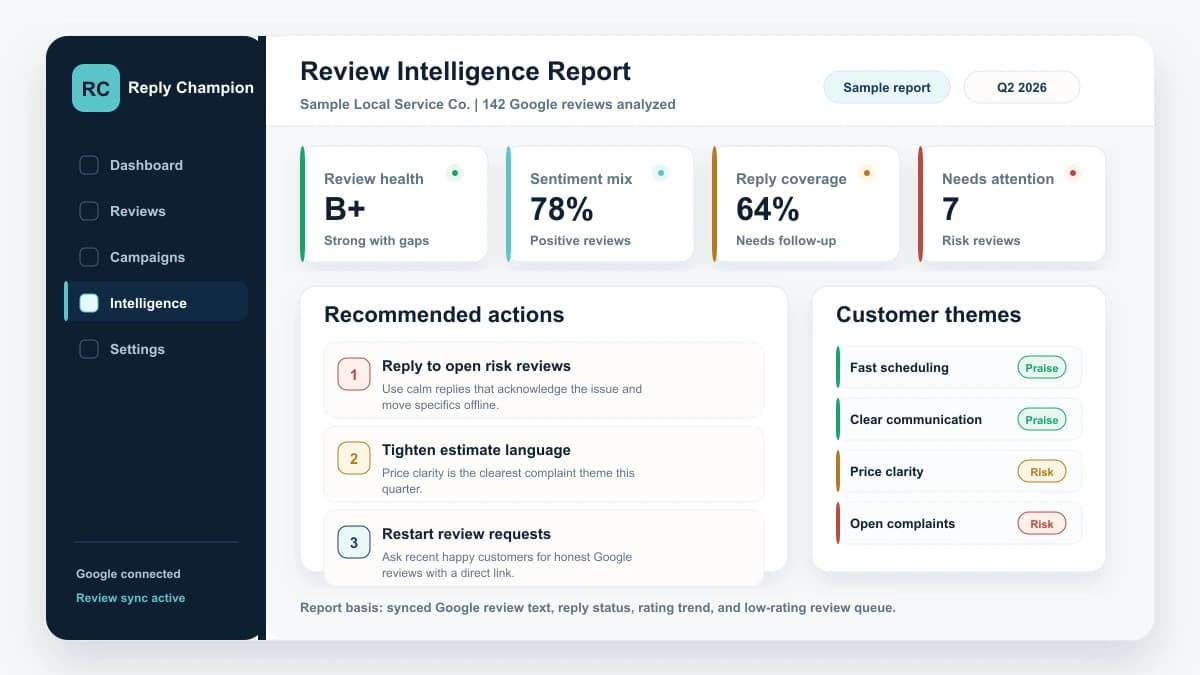
Sample Review Intelligence output
Customer feedback analysis should end with a short action list
The useful version is not a giant export of comments. Reply Champion turns Google reviews into a practical operating snapshot: what customers trust, what makes them hesitate, which public replies are missing, and what the team should do next.
View the full sample reportDemo snapshot
Quarterly customer feedback analysis
Review health
B+
Strong recent rating, but low-rating replies and review flow still need attention.
Recurring praise
Staff, speed, clarity
The language customers repeat most often in 4-5 star reviews.
Recurring concern
Pricing expectations
The theme most likely to create doubt when future customers read the profile.
Next action
Reply, request, tighten handoff
A practical queue instead of another dashboard your team has to interpret.
Demo data only. Real reports use the connected business profile and synced Google review history.
Reply Champion Review Intelligence
What customers keep trying to tell you
Review Intelligence looks for the gap between a pile of Google reviews and the operating decisions hidden inside them. Each finding should connect a customer signal to what it means and what the business should do next.
For a concrete industry example, see how car wash review management turns repeated comments about wash quality, drying, equipment, attendants, wait times, and memberships into location-level signals.
Personal-care teams can use the same method with different taxonomies: salon review management tracks consultation, services, stylists, appointments, and recovery, while barbershop review management separates barber mentions, cut consistency, walk-in waits, appointments, and shop experience.
Recurring complaint themes
Signal: Price expectations keep showing up in low-rating reviews, even when customers say the work itself was good.
Meaning: The trust gap is not only the invoice. It is how clearly expectations were set before the customer saw the final cost.
Next move: Tighten estimate language and use short, non-defensive replies for billing complaints.
Praise themes worth repeating
Signal: Customers repeatedly mention fast scheduling, clear communication, and staff names in 4-5 star reviews.
Meaning: Those are not throwaway compliments. They are the proof points future buyers are already using to compare the business.
Next move: Reference those details in replies and review requests so the strongest customer language stays visible.
Low-rating reply queue
Signal: Several 1-3 star reviews are still unanswered, including detailed complaints future customers are likely to read first.
Meaning: The business may have resolved the issue privately, but the public profile still looks unattended.
Next move: Draft calm public replies and route sensitive reviews through approval before posting.
Six-month review trend
Signal: The average rating is strong overall, but recent review flow slowed after a busy quarter.
Meaning: A healthy profile can still look stale if new customers are not leaving fresh feedback consistently.
Next move: Restart review request campaigns and watch whether recent review volume recovers.
Unanswered review risk
Signal: Positive reviews are getting quick replies, while mixed reviews and detailed complaints wait longer.
Meaning: The reviews that need the most careful response are also the ones most likely to stay visible without context.
Next move: Prioritize mixed and negative reviews before simple praise, then backfill positive replies.
Location or team patterns
Signal: One location gets stronger praise for communication while another location has more scheduling complaints.
Meaning: The issue may be operational, not reputational. Reviews can point to where the customer experience differs.
Next move: Use the pattern in the manager conversation, then monitor whether future reviews change.
What the customer feedback analysis tool surfaces
Review Intelligence is useful because it turns customer language into a short list of patterns owners can actually use. The goal is not a spreadsheet of comments; it is a clear view of what customers praise, what they distrust, and which public replies or review requests should happen next.
Sentiment mix
Positive, mixed, and negative review patterns across recent Google reviews.
Recurring themes
The service, staff, speed, pricing, communication, and location topics customers repeat.
Rating trend
Six-month review health so owners can see whether feedback is improving or slipping.
Low-rating queue
Visible complaints and unanswered negative reviews that should be handled first.
Reply coverage
Which reviews have public replies and which locations are falling behind.
Quarterly report
Review Intelligence summaries that turn customer feedback into next actions.
How the analysis works
How do you analyze Google reviews?
Start with the actual review text and response status, then work toward the actions that change the public profile. The useful analysis is not a word cloud. It is a review workflow with priorities.
Read public Google review text
The analysis starts with the review language future customers already see in Search and Maps, not a private survey export.
Group repeated customer themes
Praise, complaints, service details, staff mentions, price concerns, scheduling issues, and location patterns are grouped into practical signals.
Check response and trust gaps
Low-rating reviews, unanswered complaints, stale review flow, and weak reply coverage get surfaced because those gaps shape trust.
Connect each finding to action
The finding should point to a review reply, approval decision, review request campaign, profile-health issue, or customer experience fix.
The customer feedback that matters most is often public
Surveys and support tickets are useful, but they do not usually sit on your Google Business Profile while customers compare you against competitors. Google reviews are feedback and sales proof at the same time.
That is why Reply Champion treats customer feedback analysis as part of review management. The product helps you see sentiment mix, rating trends, recurring themes, and what needs attention, then respond publicly with the right tone and keep fresh feedback coming from real customers.
What Reply Champion does after the analysis
Sync Google reviews
Reply Champion connects to your Google Business Profile and brings review text, rating, language, and response status into one dashboard.
Identify feedback that affects trust
Low-rating reviews, unanswered complaints, sentiment mix, recurring themes, stale review flow, and weak reply coverage are surfaced because those are the patterns buyers notice.
Draft the right public response
The AI writes from the actual customer feedback, star rating, language, business context, and tone settings instead of using a generic template.
Close the loop with more reviews
AI Review Intelligence shows whether feedback is improving, while review request campaigns help you ask real customers for honest feedback with direct Google review links and private feedback collection.
Not another survey tool
Reply Champion is built for public Google review feedback: the feedback future buyers read before they call, book, or visit.
Surveys
Useful for structured questions and private research, but easy to ignore when buyers are looking at Google.
Support tickets
Useful for internal issue tracking, but usually disconnected from the public profile that shapes trust.
Google reviews
Public, searchable, high-intent feedback that directly affects whether a customer calls, books, or chooses a competitor.
Customer feedback analysis should lead to action
Connect your Google Business Profile, keep replies moving, protect sensitive complaints with approval controls, ask real customers for honest reviews, and track sentiment, themes, rating trend, and review health in one workflow.
Customer feedback analysis FAQ
What is customer feedback analysis?
What is a customer feedback analysis tool for Google reviews?
How does Reply Champion analyze customer feedback?
What tool is used to analyze Google reviews?
How do you analyze Google reviews?
Is Reply Champion a survey platform?
Why use reviews for customer feedback analysis?
How is this different from a free review audit?
Is this a Google review analysis tool or customer feedback analysis software?
What should a business do after analyzing customer feedback?
Want a quick snapshot before connecting Google?
The review audit gives a lightweight look at a public profile. Reply Champion is for businesses that want customer feedback managed continuously through reviews, replies, approvals, and review requests.