Reply Champion Research · Updated
Google Review Response Benchmark 2026
How businesses use automatic replies and human approval. Original findings from Reply Champion’s records, shaped by customer settings and the reviews they receive.
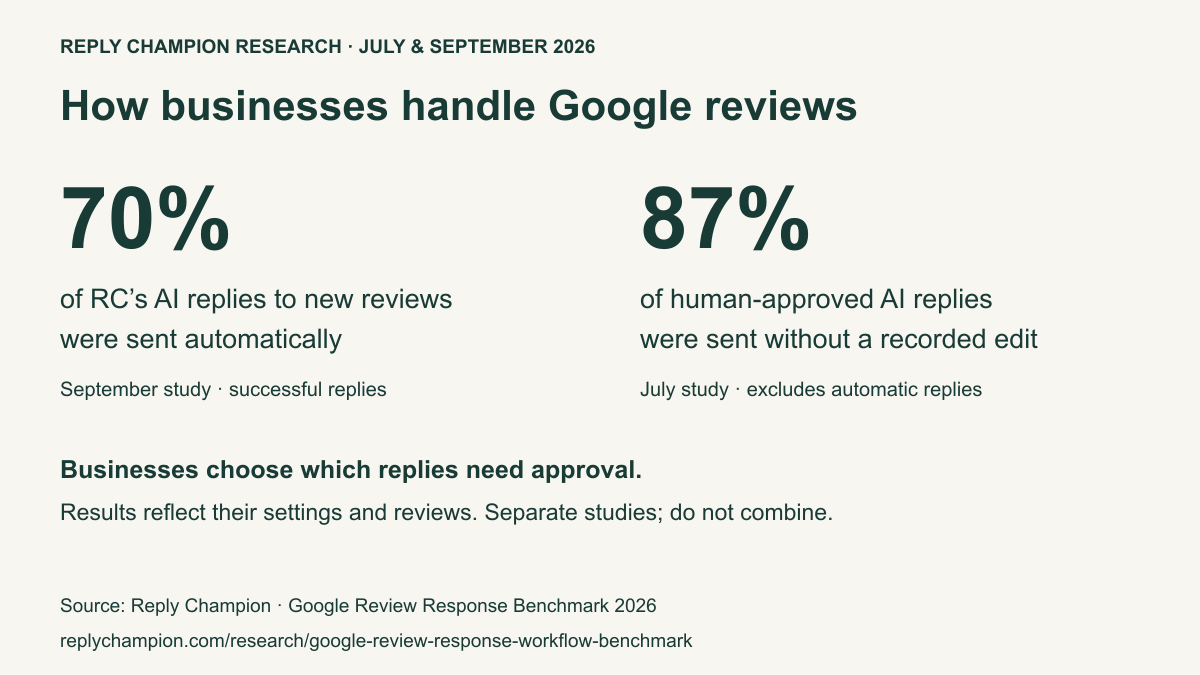
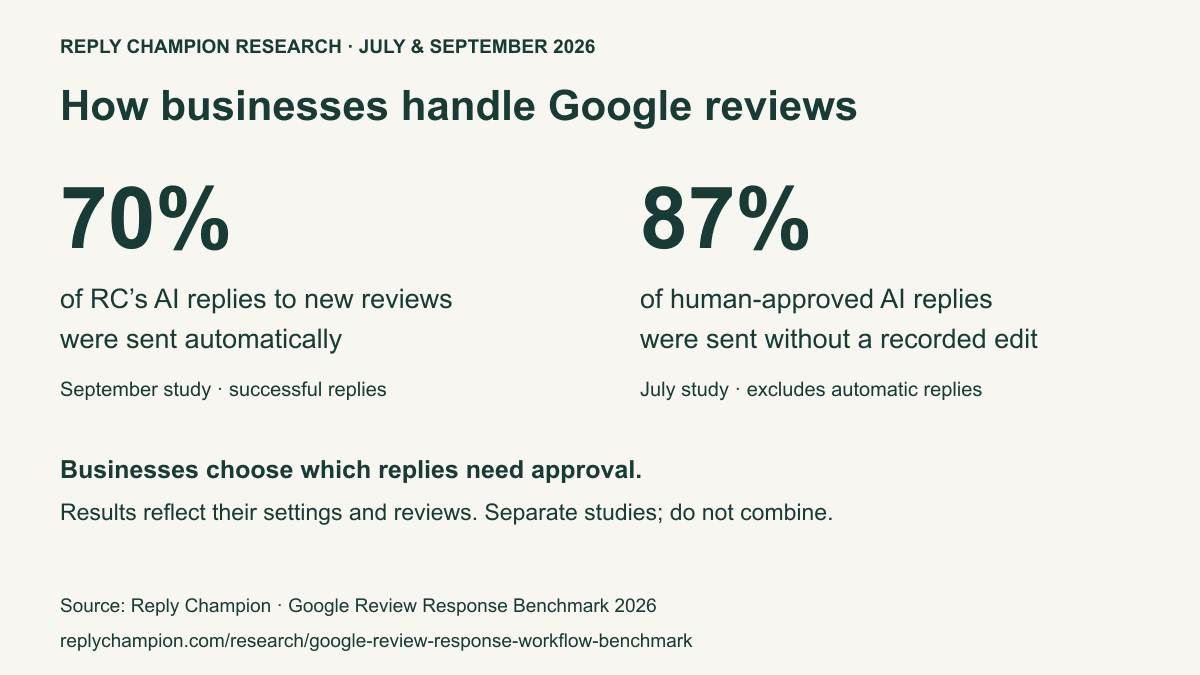
Two findings to know
- 70%
- of RC’s AI replies to new reviews were sent automatically.Businesses choose which replies can be sent automatically and which need approval. This result reflects their settings and reviews.September study: see the finding
- 87%
- of human-approved AI replies were sent without a recorded edit.Only replies that went through human approval are included.July study: see the finding
These findings come from separate studies. They cannot be combined or read as a change over time. They are not industry averages.
01 · September 2026
How often were replies sent automatically?
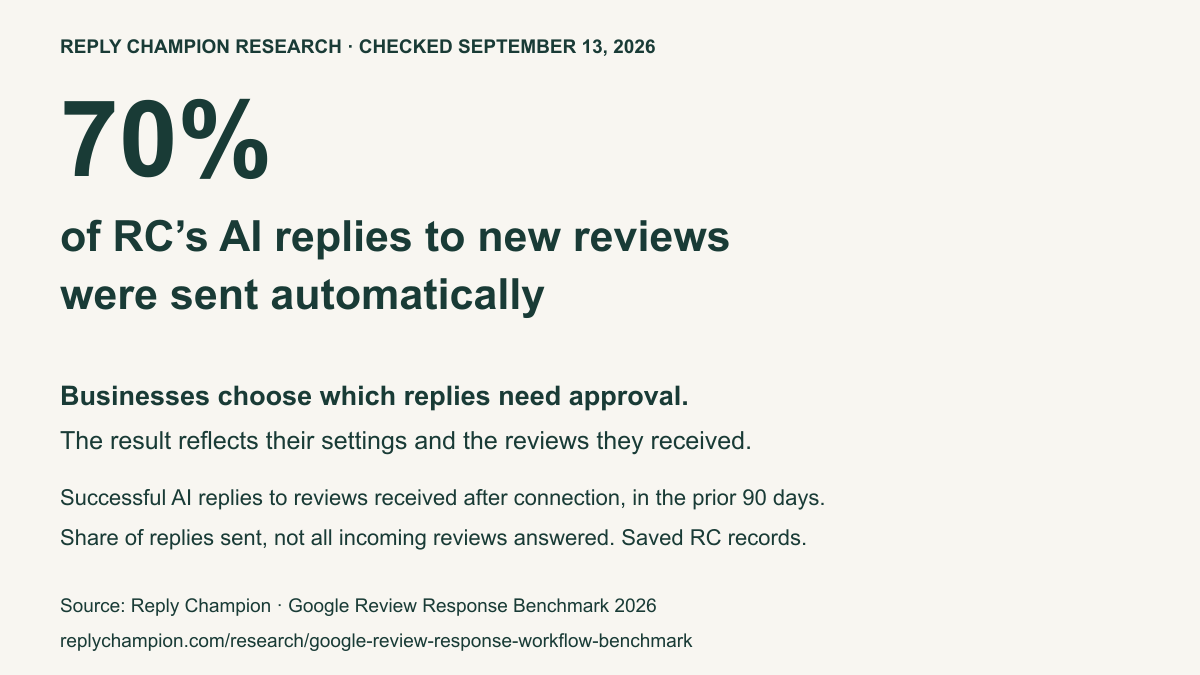
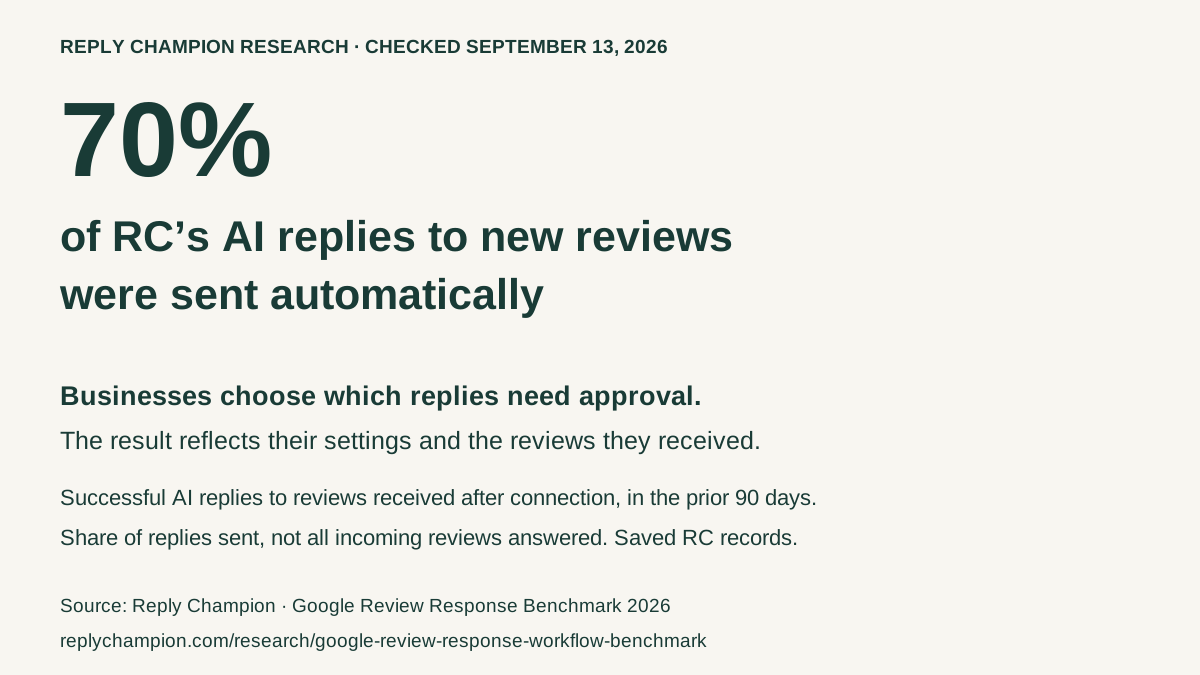
70% of RC’s AI replies to new reviews were sent automatically.
Businesses choose which replies can be sent automatically and which need approval. This result reflects their settings and the reviews they received.
- Sent automatically
- 70%
- Sent after human approval
- 30%
What this means: these automatic replies did not need a person to approve each one. Your results depend on your settings and reviews.
New reviews means reviews received after connection to RC, during the study period. This measures replies RC sent, not how many incoming reviews got an answer.
Source: Reply Champion · checked September 13, 2026 · Methods and limits
02 · July 2026
Do approved AI replies need editing?
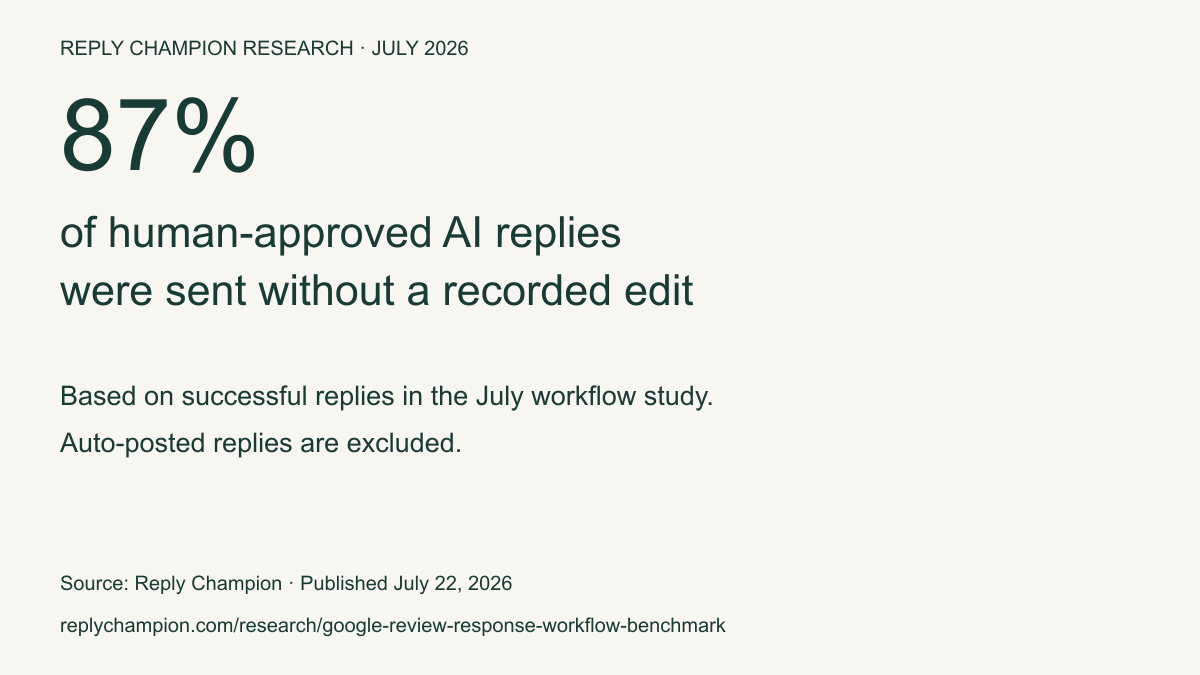
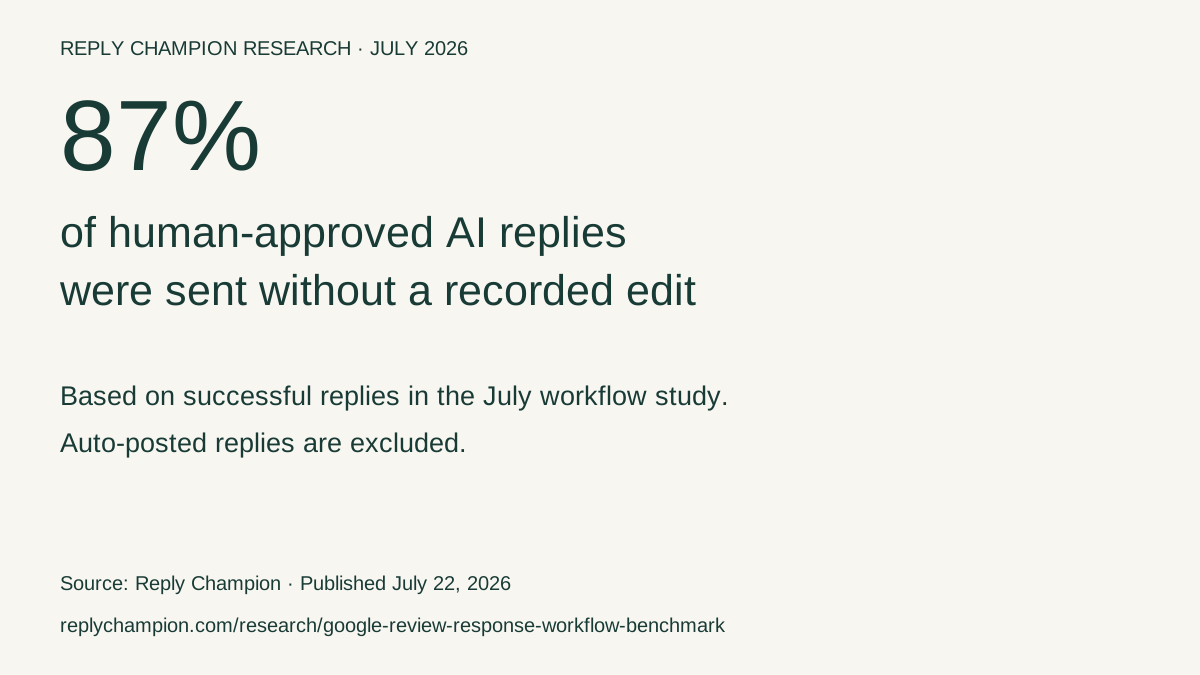
87% were sent without a recorded edit. These replies went through human approval; auto-posted replies are excluded.
- No recorded edit
- 87%
- Recorded edit
- 13%
What this means: many drafts were ready for the approver to send. An approval step still lets someone change the wording when needed.
Source: Reply Champion · July 22, 2026 · Methods and limits
Supporting finding · July 2026
Do businesses keep a person in control?
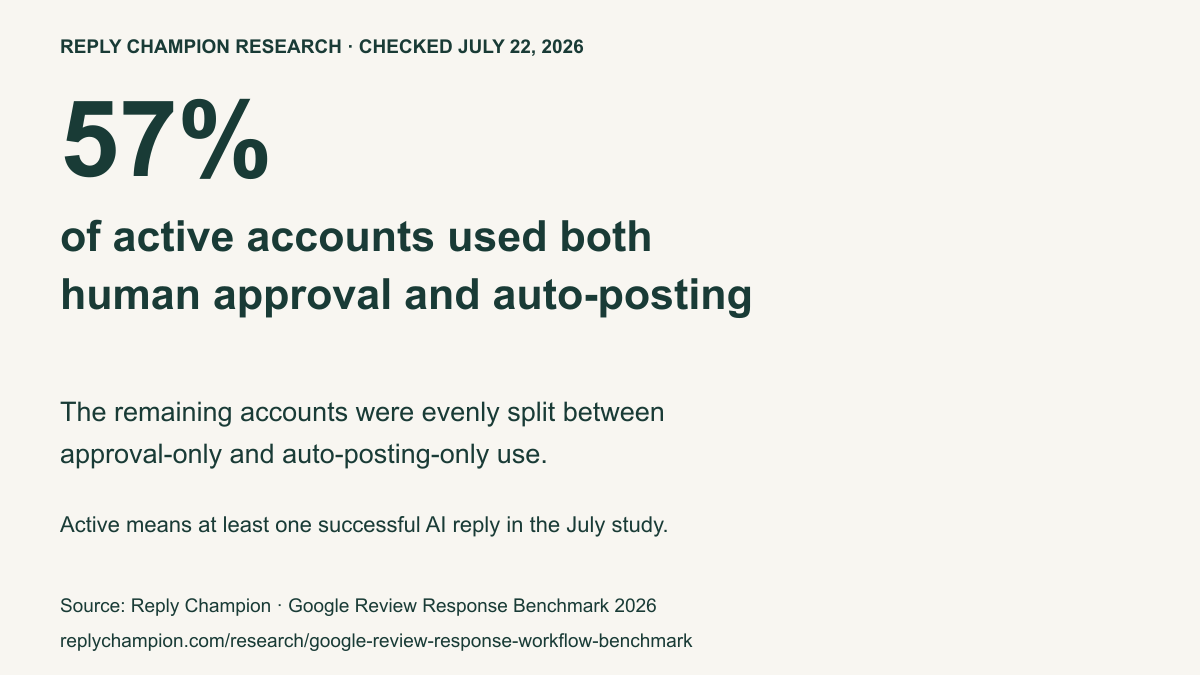
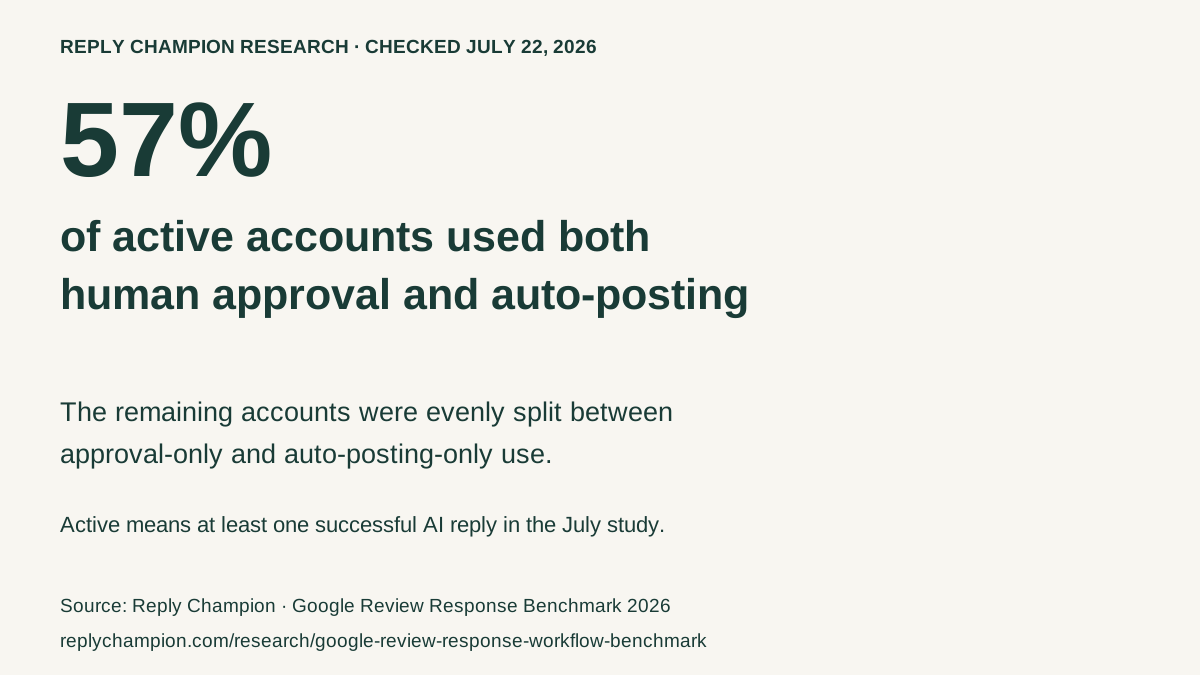
57% of active accounts used both human approval and auto-posting. The rest were evenly split between using only approval or only auto-posting.
Human approval was more common for lower-rated reviews:
- 1–4-star reviews
- 88%
- 5-star reviews
- 74%
What this means: businesses can automate some replies and review others before they are sent.
Source: Reply Champion · July 22, 2026 · Methods and limits
What can you do with these findings?
- Keep approval where it helps. Decide which replies can be sent automatically and which you want to read first.
- Make each reply relevant. Address what the customer said, even when an AI draft needs no edits.
Why replies matter to customers: in BrightLocal’s 2026 US consumer survey, 81% expected a reply within a week, and 50% said generic or templated replies made them unlikely to choose a business. These are stated preferences, not measured sales results. Read the survey.
Google says more reviews and positive ratings can help local ranking. It does not say replying alone improves ranking. Google’s guidance.
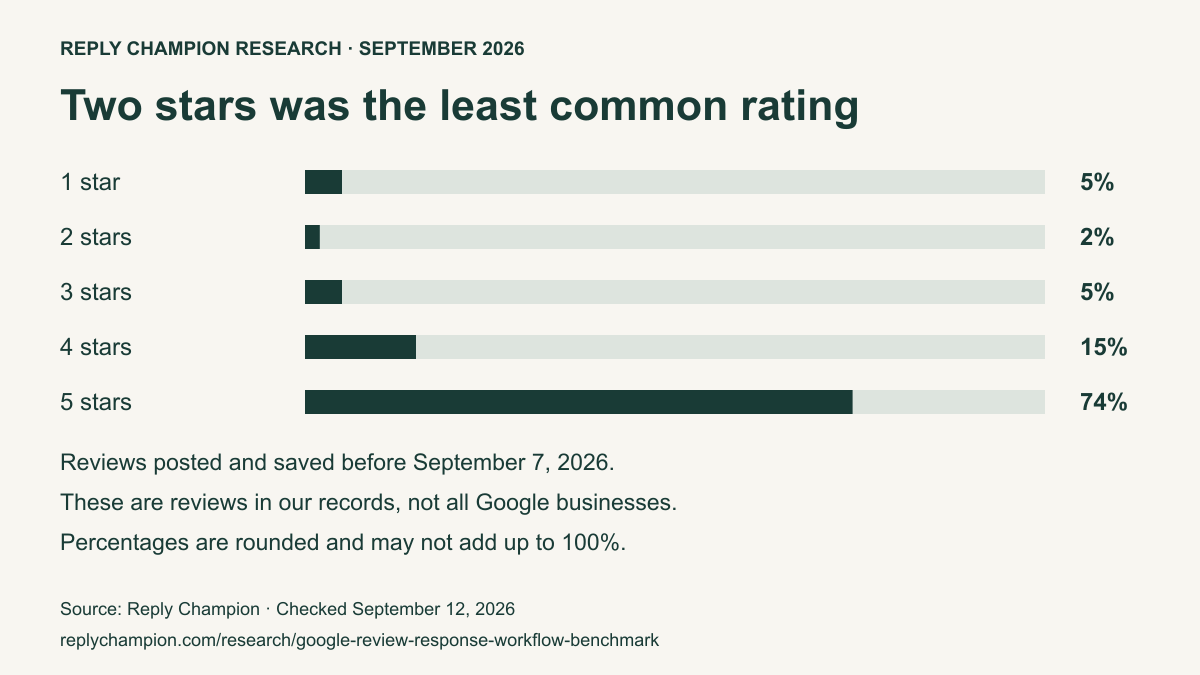
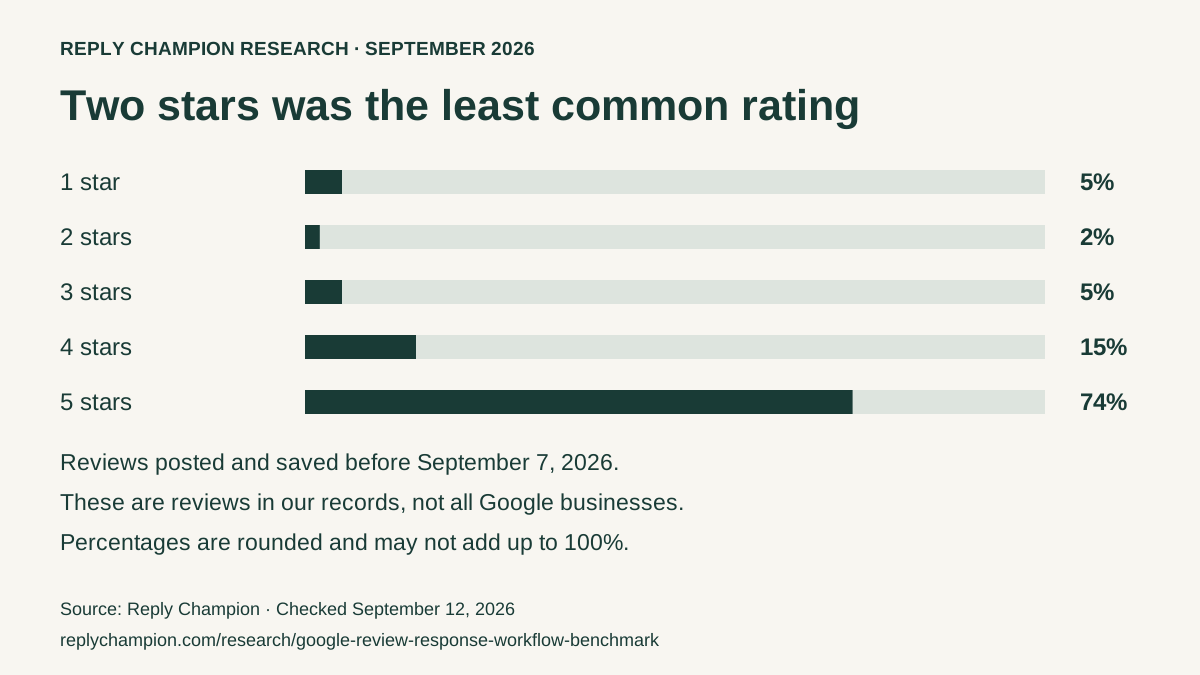
Another finding: two-star reviews are rare
About 2% of the reviews in our ratings study gave two stars. It was the least common rating. We don’t know why.
Checked September 12, 2026, using reviews posted and saved before September 7. These are reviews in our records, not all Google businesses. Percentages are rounded.
How we checked
We used Reply Champion’s saved records. We excluded internal accounts and likely test businesses. Percentages are rounded. The studies below use different groups and dates.
July study: approval and automation
Checked July 22, 2026. The successful AI reply records in the study ran from March 18 to July 22, 2026. An active account had at least one successful AI reply. This does not mean every registered or paying customer.
The editing percentage covers successfully posted AI replies that went through human approval. Auto-posted replies are excluded. The rating comparison also uses successfully posted AI replies. No recorded edit does not measure customer satisfaction or the quality of every reply.
September study: automatic replies
Checked September 13, 2026, at 22:28:48 UTC. The study covers new reviews received in the preceding 90 days, after each business connected to RC. We included successful AI replies whose text matched the current saved reply. Removed reviews and very small business groups were excluded.
The 70% figure is the share of those replies marked as posted automatically. Eligible businesses were included whether or not they used automatic posting. Businesses choose their settings, and the reviews they receive also affect the result. This does not measure the share of all incoming reviews answered.
Businesses with more replies have more weight. Excluding the largest businesses changed the result to 79%. Excluding reviews selected for cleanup left it at 70%. Shorter study periods gave 75–76%; allowing every review at least a week of follow-up gave 69% for the 90-day period.
Automatic posting skips per-reply approval. We did not measure setup, manually started generation, or time spent managing replies. Current saved text and dates can change, so these records are not a complete history of every reply. This is a separate study from the July approval findings.
September ratings study
Checked September 12 using Google reviews posted and saved before September 7, 2026, at midnight UTC. We excluded removed reviews, internal accounts, likely test businesses, and businesses without a Google place ID.
Each review counts once. Two stars remained the least common overall when we excluded the largest businesses, gave businesses equal weight, and checked recently synced businesses with matching saved and Google review totals. Matching totals do not prove every review is present. The result did not hold at every business.
We do not publish review, business, account, or response sample counts. That limits independent assessment of the findings. These records do not represent all Google businesses. None of the studies measured improvements in rankings, ratings, revenue, customer satisfaction, or time saved.
Use the findings
Credit Reply Champion and link to this report. Keep the study date and scope with each number. The outside research belongs to its named sources.
Reply Champion, Google Review Response Benchmark 2026. Published July 22; updated September 13, 2026.
https://www.replychampion.com/research/google-review-response-workflow-benchmark
70% of Reply Champion’s AI replies to new reviews were sent automatically in its September 2026 study. The result reflects businesses’ settings and the reviews they received.
87% of human-approved AI replies in Reply Champion's July study were sent without a recorded edit.
- Download all report statistics (CSV)
- Download statistics and notes (JSON)
- Download the report overview (PNG)
Common questions
What does this benchmark measure?
Does “without an edit” include auto-posted replies?
Will 70% of my replies be sent automatically?
Can I use these findings in an article or presentation?
Build a reply routine you can keep up with
Catch up on old reviews, use AI drafts, and choose which replies need your approval.