Platform decision guide
Google Reviews vs Trustpilot: Start With Google
If nearby customers find you in Search or Maps, put your next 90 days into Google reviews. Trustpilot earns a test only when your business is online-first and branded proof affects the sale.
Default for eligible local businesses
Google first for 90 days
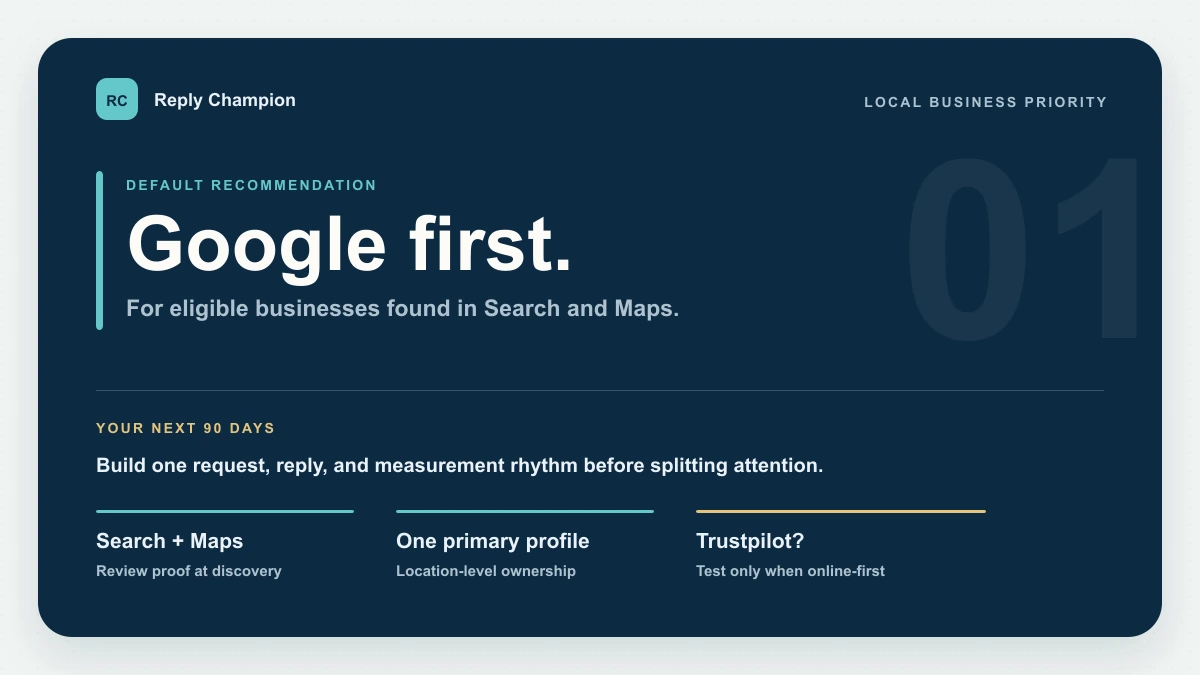
Google Reviews and Trustpilot are both public review ecosystems, but they do different jobs. Google is part of local discovery. Trustpilot is a separate destination and website-proof layer. For a plumber, dentist, restaurant, salon, repair shop, or other location-led business, that distinction matters more than a long feature checklist.
Our recommendation is deliberately Google-first: give Google one focused 90-day operating cycle before splitting requests, replies, and reporting across another platform. The main exception is an online-first business whose buyers already know the brand and need additional proof before completing a purchase.
Google Reviews vs Trustpilot at a glance
| Decision factor | Google reviews | Trustpilot |
|---|---|---|
| Where reviews appear | On an eligible Google Business Profile in Google Search and Maps. | On a Trustpilot company profile and, where supported, in website and marketing displays. |
| Best starting fit | Storefront, service-area, and multi-location businesses. | Online-first ecommerce, SaaS, and national brands evaluating independent website proof. |
| Cost boundary | An eligible Business Profile can be added or claimed at no charge. | Basic business services are free. Paid invitations, widgets, analytics, and limits vary by plan. |
| Request workflow | Share the direct Google review link or QR code with eligible customers. | Receive organic reviews or use supported, fair, neutral invitation methods. |
| Rating model | The displayed score is the average of ratings published on Google. | TrustScore considers review count, review age, and Trustpilot's weighting model. |
| Local visibility | Google says more reviews and positive ratings can help local ranking. Relevance, distance, prominence, and other factors still apply. | Trustpilot reviews do not become native Google Business Profile ratings. Google may display third-party review information in some contexts. |
| Reply Champion support | Supported: Google review monitoring, requests, replies, approvals, and analysis. | Not supported: Reply Champion does not collect or manage Trustpilot reviews. |
The short version is simple: Google helps a local customer discover and compare you; Trustpilot more often helps a customer validate a brand they already know. That is why Google gets our default recommendation for local businesses.
Use the five-minute platform-priority worksheet
Answer the five questions below based on your real buyer journey, not which platform has the better sales page. The result gives you one primary operating recommendation for the next 90 days.
Five-minute decision
Which review platform should you prioritize?
Answer five operating questions. Your answers stay in this browser and are not saved.
Why should most local businesses prioritize Google reviews?
Google reviews sit next to the business information a nearby customer is already evaluating: location, hours, phone number, website, directions, photos, and other profile details. Google explicitly says Business Profile reviews appear in Search and Maps, and that more reviews and positive ratings can help local ranking. It also says there is no way to request or pay for a better local ranking.
That gives Google three practical advantages for an eligible local business:
- The review proof appears during discovery. A customer does not have to visit another review site before seeing the rating and review count.
- The workflow is tied to each eligible location. That makes Google the more natural system for a restaurant, practice, shop, or service area that competes locally.
- The operating cost is easier to justify. A Business Profile can be added or claimed at no charge, so the first investment is consistent customer requests, thoughtful replies, and measurement, not a second platform subscription.
Google-first does not mean “collect as many five-star reviews as possible.” Ask real eligible customers for honest feedback, never offer an incentive, and never route only happy customers to the public review form. Use the direct Google link or QR code, respond professionally, and measure what changes.
Google-first recommendation
If customers search for your category plus a city, neighborhood, “near me,” or a map result, treat Google as the primary platform until your profile, request cadence, response coverage, and review recency are all under control.
When does Trustpilot deserve a controlled test?
Trustpilot is strongest when the review is serving a different moment: the customer already knows the company, reaches its website, and wants independent reassurance before purchasing. That can make sense for an ecommerce store, online subscription business, SaaS company, or national brand without a meaningful local discovery journey.
Trustpilot's basic business services include reading, replying, inviting, and reporting reviews. Paid plans add different invitation limits, widgets, analytics, and other features. On August 24, 2026, Trustpilot's US pricing page listed a free plan and paid annual commitments beginning at $99 per month per domain. Pricing and plan details are volatile, so verify the current terms before publishing a budget or ROI case internally.
A sensible Trustpilot test needs all three of these:
- A named buyer moment: checkout, product page, proposal review, or branded “is this company legitimate?” search.
- A frozen baseline: current conversion rate or qualified sales action before adding the Trustpilot workflow.
- A stop rule: a 28- and 56-day review that includes the full subscription and operating cost.
Without those conditions, a second review profile often becomes another inbox to neglect. For a local business whose buyers start in Google Maps, that is usually a worse use of time than strengthening Google.
When should a business use both Google and Trustpilot?
Use both when the business genuinely has two meaningful buyer journeys, not because a reputation checklist says every profile must be active.
A multi-location retailer with a large ecommerce operation is the clearest example:
- Google remains primary for each location. Customers use Search and Maps to compare nearby stores, hours, directions, and local experiences.
- Trustpilot can support the online brand layer. The ecommerce team can test company-level proof on the website or around branded purchase research.
- Each platform needs a separate owner and metric. Location teams should not be forced to operate an online-brand workflow, and the ecommerce team should not dilute local review requests.
Even in that hybrid case, “both” should mean Google primary, Trustpilot purposeful, not an automatic 50/50 split.
Three business examples
Emergency plumber: Google first
The customer searches for help nearby, compares the local pack, checks ratings and recent comments, and calls. The plumber should focus on a verified Google Business Profile, one post-job review request moment, fast professional replies, and monthly review analysis. Trustpilot adds another profile but does not replace this Search and Maps journey.
Direct-to-consumer ecommerce brand: test Trustpilot
The customer discovers the product through an ad, creator, marketplace, or branded search and then evaluates the website. If independent website proof is a real conversion objection, the brand can test Trustpilot against a frozen checkout or qualified-sales baseline. It should still avoid assuming that a widget or TrustScore automatically creates conversion lift.
Multi-location retailer with ecommerce: both, Google primary
Each store needs its own Google review workflow because local experiences and discovery differ by location. The ecommerce business can separately evaluate Trustpilot for the company-level online journey. One review request should not bounce randomly between platforms; the request destination should match the actual customer experience being reviewed.
How do Google and Trustpilot review policies differ?
The safest operating rule is similar on both platforms: ask people with a genuine experience, use neutral language, do not offer a reward, and do not pressure someone to write, edit, or remove a review.
Google prohibits incentives such as free or discounted goods or services in exchange for posting, changing, or removing reviews. Trustpilot's business guidelines also prohibit incentives and require invitations to be fair, neutral, and non-selective. Trustpilot specifically warns businesses not to cherry-pick customers expected to leave positive reviews.
Neither platform promises that a business can remove a review simply because it is negative or disputed. Flagging should be reserved for reviews that may violate the relevant policy.
Your Google-first 90-day plan
- Day 0: freeze the baseline. Record rating, total review count, reviews in the last 30 and 90 days, response coverage, unanswered reviews, and the profile actions you can measure.
- Days 1–14: fix the operating basics. Verify the profile, test the direct review link, choose one eligible request moment, assign reply ownership, and resolve old unanswered reviews.
- Days 15–28: run consistently. Ask eligible customers for honest Google reviews without incentives or sentiment filtering. Reply with useful, non-defensive language.
- Day 28: take the first reading. Compare review volume, recency, response coverage, calls, directions, and website actions with the prior window. Treat movement as directional unless you have a valid control.
- Day 56: take an independent second reading. Use days 29–56 as a separate window. Keep the workflow if customers are participating and the operating metrics are improving.
- Day 90: decide whether another platform has a distinct job. Add Trustpilot only when a real online or branded-proof use case remains unserved and the team can measure it.
You can start by running a free Google review analysis, then use the Google review acquisition guide and Google review management workflow to close the gaps.
Where Reply Champion fits
Reply Champion is intentionally focused on Google. It helps eligible businesses monitor Google reviews, request honest feedback, draft and publish replies under business rules, hold sensitive responses for approval, and turn review patterns into recurring Review Intelligence.
Reply Champion does not collect, host, import, or respond to Trustpilot reviews. If your worksheet says Trustpilot deserves a controlled test, use Trustpilot's own current documentation and measure that test separately. If Google is your priority, Reply Champion is built for that workflow.
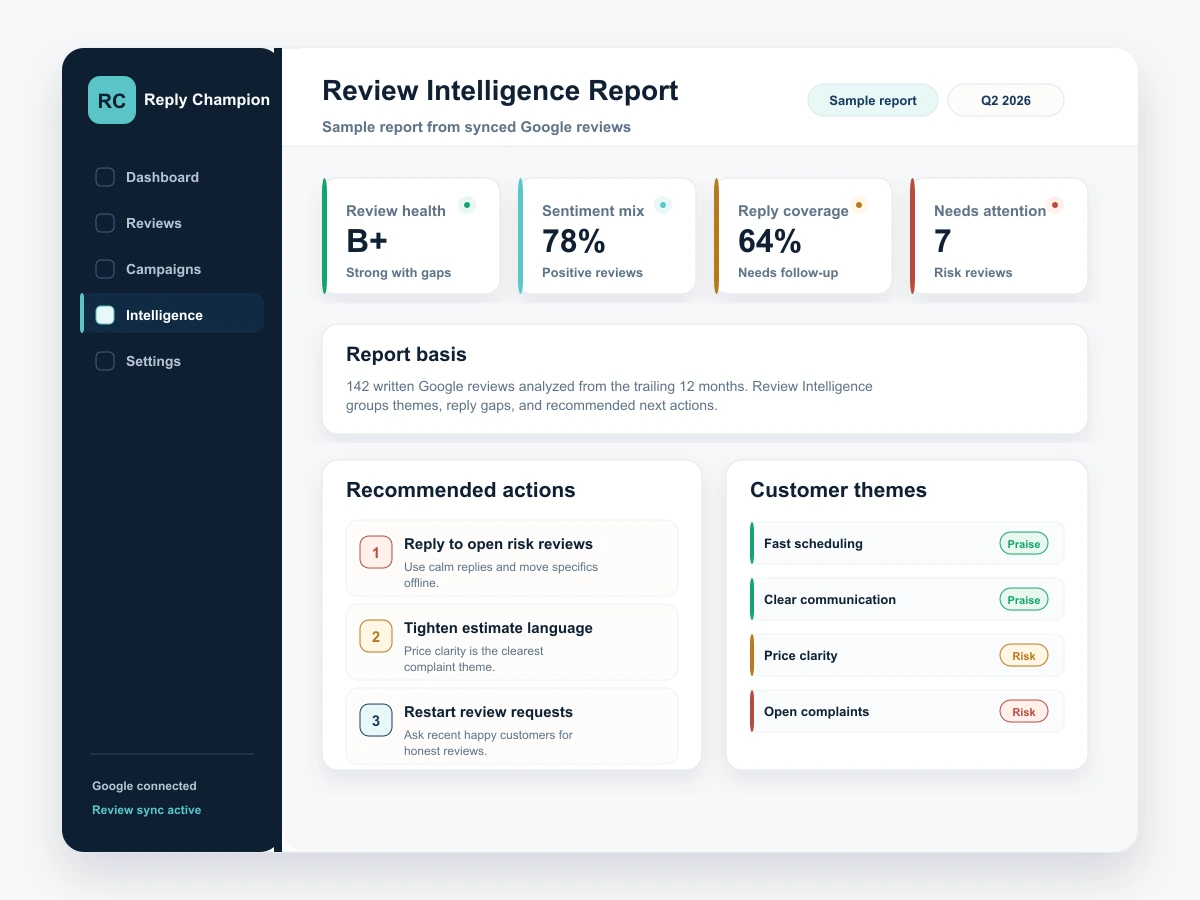
Analyze your Google reviews free to see your rating, recency, response coverage, and most important gap before deciding what to do next.
Frequently asked questions
Is Trustpilot better than Google reviews for a local business?
Usually no. For an eligible local business whose customers discover it in Search or Maps, Google reviews appear closer to the buying decision and should usually be the first priority. Trustpilot becomes more relevant when the business is online-first and needs independent brand proof on its website or around branded purchase research.
Do Trustpilot reviews appear on a Google Business Profile?
Trustpilot reviews do not become native Google Business Profile reviews or change the profile's Google rating. Google says Business Profiles may display third-party review information in some contexts, but the source remains separate and businesses cannot choose which third-party source appears.
Do Trustpilot reviews help Google local rankings?
Google says local results are mainly based on relevance, distance, and prominence, and that more reviews and positive ratings can help local ranking. That guidance is about the local Google profile and does not say that collecting Trustpilot reviews will improve a Google Business Profile's local ranking.
Can a business use Google reviews and Trustpilot at the same time?
Yes. A hybrid business can use Google for location-level discovery and Trustpilot for a distinct online-brand journey. Give each platform a named owner and metric, keep Google primary for eligible locations, and stop splitting effort if the secondary platform produces no qualified signal.
Which platform is free for businesses?
An eligible Google Business Profile can be added or claimed at no charge. Trustpilot also offers basic business services for free, while paid plans add different invitation, widget, analytics, and other capabilities. Check current Trustpilot pricing before making a budget decision.
How are Google ratings and Trustpilot TrustScores calculated?
Google says its displayed review score is the average of all ratings published on Google for that place or business. Trustpilot says TrustScore uses the number and age of reviews plus a weighting model, so the two displayed scores should not be treated as identical calculations.
Can businesses offer incentives for Google or Trustpilot reviews?
No. Google prohibits incentives connected to posting, changing, or removing a review. Trustpilot also prohibits incentivized reviews and requires fair, neutral invitations. Ask for honest feedback without discounts, gifts, refunds, contest entries, or requested star ratings.
Does Reply Champion manage Trustpilot reviews?
No. Reply Champion manages Google review requests, replies, approvals, monitoring, and analysis. It does not collect, host, or manage Trustpilot reviews.
Sources and editorial disclosure
Reply Champion sells Google review-management software, so this guide has a Google-focused product perspective. The recommendation is based on the buyer journey and official platform documentation, not a claim that Google is universally better for every business.
- Google Business Profile Help: Tips to get more reviews, checked August 24, 2026.
- Google Business Profile Help: Tips to improve local ranking, checked August 24, 2026.
- Google Business Profile Help: Add or claim your Business Profile, checked August 24, 2026.
- Google Business Profile Help: Understand review scores, checked August 24, 2026.
- Google Business Profile Help: About third-party reviews, checked August 24, 2026.
- Trustpilot Trust Centre,
corporate.trustpilot.com/trust, checked August 24, 2026. - Trustpilot Guidelines for Businesses,
legal.trustpilot.com/for-reviewers/guidelines-for-businesses, checked August 24, 2026. - Trustpilot Business Pricing,
business.trustpilot.com/pricing, checked August 24, 2026.
Limitations: platform features, prices, policies, and search presentation can change. The three business scenarios are editorial examples, not Reply Champion customer outcomes. No platform guarantees rankings, review growth, traffic, trust, revenue, or conversions.

Reply Champion Team
The Reply Champion team writes about review management, local SEO, and Google Business Profile strategy, drawing on direct experience operating the Reply Champion platform.
Ready to save time on review responses?
Reply Champion automatically responds to your Google reviews with personalized, professional messages.
Start Free 7-Day Trial →Related Articles
How to Embed Google Reviews on Your Website (2026)
Every realistic way to display Google reviews on your website, compared honestly. Step-by-step installs for WordPress, Shopify, Squarespace, Wix, and custom HTML.
Can You Offer Incentives for Google Reviews?
Can you offer a discount for a Google review? No. Google prohibits discounts, gifts, contests, refunds, and other review incentives.
Review Gating Meaning, Google Policy & Safer Alternatives
Review gating meaning, Google policy risk, examples of selective review requests, and safer ways to ask for honest Google reviews.